
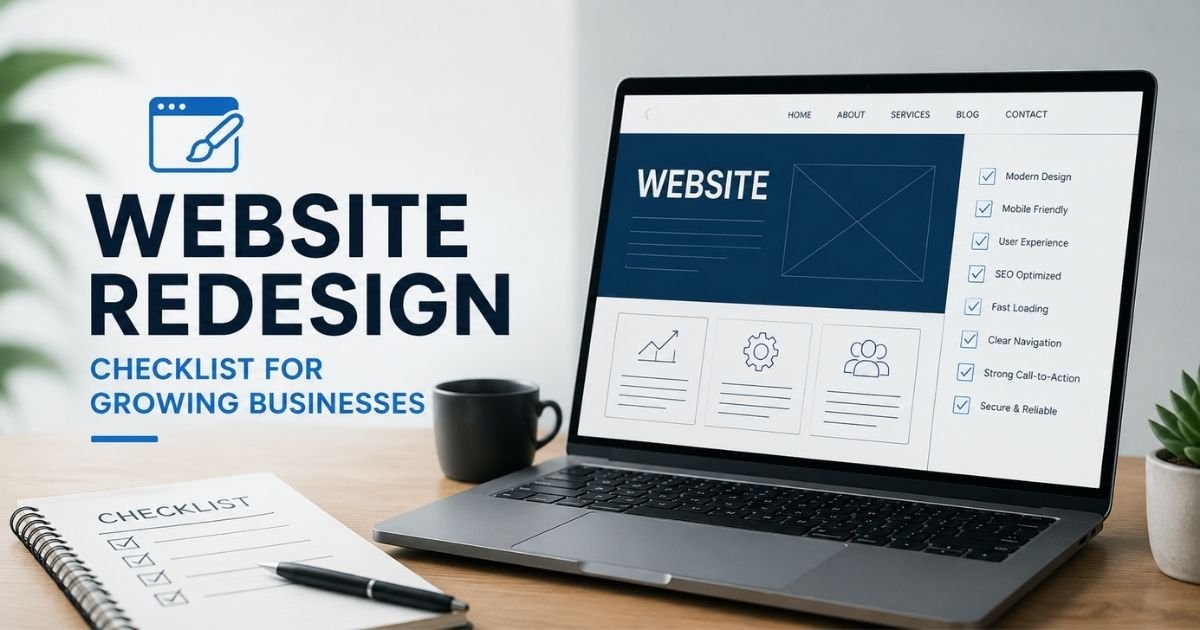
A website that worked perfectly three years ago can quietly become your biggest liability today. As businesses grow, their websites often don’t grow with them, resulting in outdated designs, slow load times, and missed opportunities to convert visitors into customers. If you’re a growing business considering website design and development services, this checklist walks through exactly what to evaluate before, during, and after a redesign.
Why Growing Businesses Need to Rethink Their Website
Growth changes everything about what a business needs from its website. A site built for a five-person startup rarely serves a fifty-person company well. New product lines, new markets, and new customer expectations all put pressure on a website that was never designed to scale.
The good news is that a redesign doesn’t have to mean starting from zero. Website design and website development done strategically can preserve what’s already working while fixing what’s holding growth back.
Step 1: Audit Your Current Site’s Performance
Before touching a single design element, understand what’s actually happening on your current site. Look at page load speed, mobile responsiveness, bounce rates, and where visitors are dropping off before converting. A redesign built on assumptions rather than data tends to repeat the same mistakes with a fresh coat of paint.
This is also the right time to review your SEO website design foundation. Are your title tags and meta descriptions doing their job? Is your site structure helping or hurting how search engines crawl and understand your content? Redesigns are notorious for accidentally tanking SEO rankings when technical elements get rebuilt without care, so this audit step protects the organic traffic you’ve already earned.
Step 2: Define What “Growing” Actually Means for Your Business
Not every growing business needs the same kind of redesign, and this is where the checklist branches based on your specific model.
If you’re an ecommerce business: Your priorities should center on ecommerce website design services that reduce friction in the buying journey. That means streamlined checkout flows, clear product photography standards, and mobile-optimized cart experiences. Ecommerce website development at this stage should also account for inventory scaling, so your backend can handle a growing product catalog without the site slowing down.
If you’re a B2B business: B2B website design typically needs to prioritize trust signals over flashy visuals, case studies, client logos, clear service breakdowns, and easy paths to request a consultation or demo. B2B website development should also support longer sales cycles, which often means building in resources like whitepapers, comparison pages, or gated content that nurtures leads over time rather than pushing for an instant purchase.
If you’re on Shopify: Shopify website design during a redesign phase should focus on theme customization that reflects your specific brand rather than looking like every other Shopify store. Shopify website development work often includes app integration cleanup too, since growing stores tend to accumulate apps that slow down page speed without adding real value.
Step 3: Prioritize Custom Elements Where They Matter Most
Not every page needs a custom build, but the pages that drive the most revenue usually do. Custom website development services are worth the investment on your homepage, product or service pages, and checkout or lead capture forms- the places where design quality directly impacts conversion.
For businesses moving upmarket, this is also where corporate website design becomes relevant. As you win larger clients or enter more competitive markets, your site needs to visually communicate the same level of professionalism your business now operates at.
Step 4: Don’t Redesign in a Vacuum
One of the most common redesign mistakes is treating the new site as a standalone design project rather than part of a broader digital strategy. Your redesign should account for how your site connects to your CRM, email marketing tools, analytics setup, and any third-party integrations your team relies on daily.
This is also the point where working with a team offering full website design and development services, rather than piecing together a designer, a developer, and an SEO consultant separately, tends to produce a more cohesive result. Redesigns involving multiple disconnected vendors are where inconsistencies and technical conflicts most often creep in.
Step 5: Plan for Post-Launch, Not Just Launch Day
A redesign isn’t finished the moment the new site goes live. Set up redirects for any changed URLs to protect your SEO equity. Monitor site speed and mobile performance in the weeks after launch, since real-world traffic often reveals issues that testing environments miss. And revisit your analytics 30, 60, and 90 days out to confirm the redesign is actually improving the metrics that matter, not just looking better.
The Bottom Line
A website redesign for a growing business isn’t just an aesthetic refresh; it’s an opportunity to fix technical debt, realign your site with where your business is actually headed, and remove friction that’s quietly costing you customers. Whether your priority is ecommerce website development, b2b website development, or Shopify website development, the businesses that get the most value from a redesign are the ones that plan it strategically rather than reactively.
Ready to redesign a site that actually keeps up with your growth? Xpo Outdoors offers website design and development services built around exactly this kind of strategic approach.