
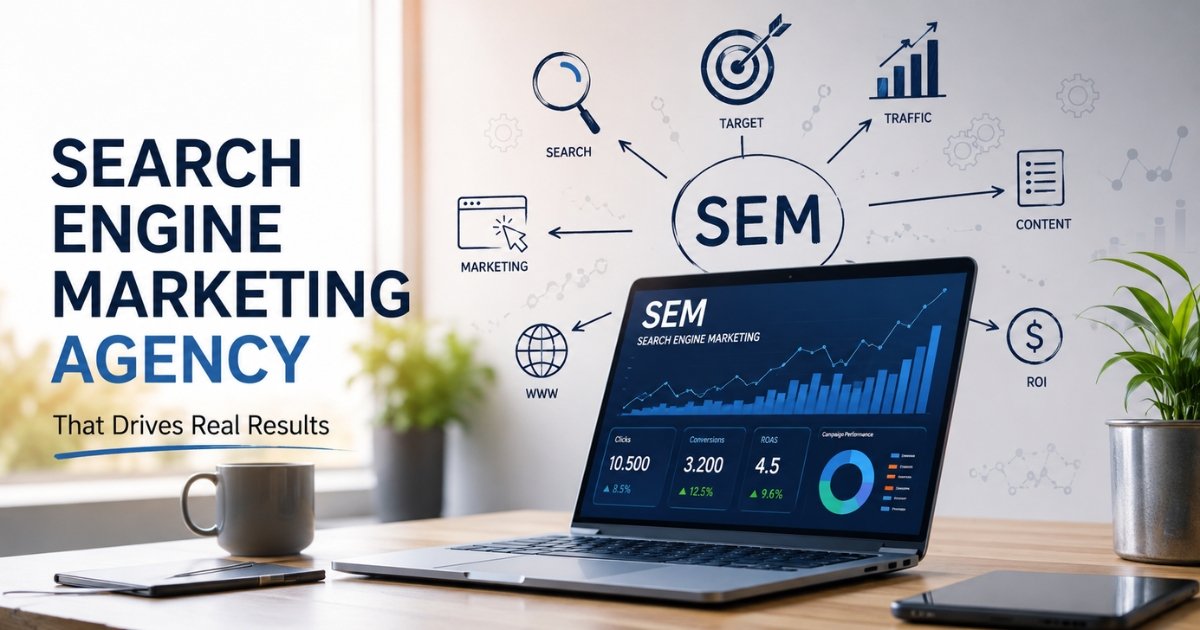
Getting found online is harder than it used to be. Even a great product or service can go unnoticed if it’s buried on page three of Google. That’s where a search engine marketing agency comes in, helping businesses show up right when potential customers are searching for what they offer.
If you’re a small business owner, startup founder, or e-commerce manager trying to figure out whether an SEM agency is worth it, this guide walks through what these agencies actually do, how the process works, what it costs, and how to pick the right partner.
What Is a Search Engine Marketing Agency?
A search engine marketing agency is a company that manages paid search campaigns most commonly Google Ads on behalf of businesses. Their goal is simple: get your business in front of people at the exact moment they’re searching for something you sell.
Think of it this way: if SEO is about earning your way to the top of search results over time, SEM is about paying for a spot there right now. An SEM agency handles the strategy, technical setup, and daily management so that the paid budget is spent on the right clicks instead of wasted ones.
For a local plumbing company, that might mean showing up when someone searches for an emergency plumber near me. For an online retailer, it might mean appearing when a shopper searches for a specific product. Either way, the agency’s job is to connect that search intent to your business.
What Does a Search Engine Marketing Agency Do?
Day to day, an SEM agency typically manages:
- Keyword research to find what customers are actually searching for
- Campaign setup across platforms like Google Ads and Microsoft Ads
- Writing ad copy that matches search intent and encourages clicks
- Bid management to control how much is spent per click or conversion
- Landing page recommendations so traffic converts once it arrives
- Conversion tracking so results can be measured accurately
- Ongoing monitoring and optimization based on real performance data
This isn’t a one-time setup. Search engine marketing services require continuous attention checking what’s working, cutting what isn’t, and adjusting as competition and search behavior change.
How Search Engine Marketing Works
A typical SEM campaign moves through a few clear stages:
1. Research and strategy. The agency learns about your business, audience, and competitors before spending a single dollar on ads.
2. Keyword selection. Rather than targeting every possible search term, a good agency focuses on keywords with real buying intent.
3. Campaign build-out. Ads, ad groups, targeting settings, and budgets are structured to match your goals.
4. Launch and tracking. Campaigns go live with conversion tracking already in place, so every click can be tied to a result.
5. Optimization. This is the ongoing part, adjusting bids, testing new ad copy, pausing underperforming keywords, and reallocating budget toward what’s converting.
Skipping any of these steps, especially tracking and optimization, is usually why SEM campaigns underperform.
Main SEM Services
Most search engine marketing companies offer a core set of services, including:
- Google Ads management the most common form of paid search marketing
- PPC advertising across search and display networks
- Remarketing campaigns to re-engage visitors who didn’t convert the first time
- Shopping ads for e-commerce businesses selling physical products
- Local search campaigns for businesses targeting a specific geographic area
- Landing page optimization to improve the odds that a click turns into a customer
Not every business needs every service. A local service business, for example, may get more value from local search and call-tracking than from shopping ads.
SEO vs SEM
These two terms get mixed up constantly, so it’s worth breaking down clearly.
| SEO | SEM | |
| Cost | No cost per click; investment in content and site work | Pay-per-click ad spend |
| Speed | Slower, builds over months | Fast, visible within days |
| Longevity | Lasting visibility once established | Stops when ad spend stops |
| Traffic type | Organic | Paid |
| Best for | Long-term brand authority | Immediate visibility, promotions, testing |
Neither one replaces the other. Many businesses use SEO and SEM together with SEM for immediate results while SEO builds momentum in the background.
Benefits of Hiring an SEM Agency
Running paid search campaigns without experience is a common way to burn through budget quickly. Working with a dedicated agency typically offers:
- More precise audience and keyword targeting
- Reduced wasted spend on irrelevant clicks
- Professional ad copy and campaign structure
- Ongoing optimization rather than a set and forget approach
- Clear reporting so you know exactly what your budget is doing
- More time for you to focus on running your business
The value isn’t just in running ads it’s in avoiding the costly trial-and-error that often happens when campaigns are managed without experience.
How Much Search Engine Marketing Can Cost
There’s no universal price tag for SEM, and it’s worth being skeptical of any agency that quotes a flat number without learning about your business first.
Total investment generally includes two parts: the ad spend paid directly to Google or another platform, and the agency’s management fee. Management fees are commonly structured as a percentage of ad spend, a flat monthly rate, or a combination of both.
Actual costs depend on your industry, competition level, target location, and campaign goals. A competitive industry like legal services or insurance will typically cost more per click than a niche local service. A transparent search engine marketing agency should be able to explain their pricing model clearly before you commit to anything.
How to Choose the Right Search Engine Marketing Agency
Look for these signs of a solid, trustworthy agency:
- Relevant experience with businesses similar in size or industry to yours
- Transparent reporting that shows real numbers, not vague summaries
- Clear communication about strategy and expectations
- Proper conversion tracking set up from the start
- Straightforward pricing with no hidden fees
- A strategy tailored to your goals, not a generic package
Be cautious of any agency promising guaranteed rankings, guaranteed leads, or specific traffic numbers; no legitimate agency can guarantee those outcomes, since search engines control their own algorithms and auctions.
Common SEM Mistakes Businesses Should Avoid
Even well-funded campaigns can underperform because of avoidable errors:
- Targeting broad, generic keywords instead of specific buyer-intent terms
- Sending paid traffic to a slow or unoptimized landing page
- Skipping conversion tracking, making it impossible to measure real results
- Ignoring negative keywords, which lets irrelevant searches drain budget
- Writing ad copy that doesn’t match what the searcher is actually looking for
- Setting a campaign live and never revisiting it
Most of these come down to the same root issue: treating SEM as a one-time task instead of an ongoing process.
Why Businesses Should Consider Xpo Outdoors
Xpo Outdoors is a digital marketing company offering a full range of services, including SEO, search engine marketing, PPC and Google Ads management, social media marketing, content marketing, and website design and development.
What sets a good SEM partner apart is understanding that paid search doesn’t operate in isolation; it works best alongside a solid website, clear conversion tracking, and a strategy built around real business goals rather than industry buzzwords. That’s the approach Xpo Outdoors takes with each client relationship.
How Xpo Outdoors Helps Businesses Improve Their Online Marketing
Rather than applying the same campaign template to every client, Xpo Outdoors builds search engine marketing strategies around each business’s specific audience, budget, and goals. This includes keyword research suited to the client’s industry, Google Ads campaign management, and landing page support to help convert the traffic that ads generate.
Because SEM results depend heavily on what happens after the click, Xpo Outdoors also supports website design and development, so paid traffic lands on pages built to convert rather than pages that simply exist.
Practical SEM Tips for Small Businesses
Small businesses can run effective SEM campaigns without enormous budgets by keeping a few things in mind:
- Start narrow with a small set of highly relevant keywords rather than casting a wide net
- Prioritize local search terms if you serve a specific city or region
- Set a realistic daily budget and adjust based on what the data shows in the first few weeks
- Make sure your landing page loads quickly and looks good on mobile devices
- Check performance weekly, even if you’re managing the campaign yourself early on
- Set up conversion tracking before launch, not after
Small, consistent adjustments tend to outperform big, infrequent changes.
Frequently Asked Questions
What is a search engine marketing agency?
It’s a company that manages paid search advertising campaigns, such as Google Ads, to help businesses appear in search results for relevant terms.
Is SEM the same as SEO?
No. SEO focuses on unpaid, organic visibility built over time. SEM refers specifically to paid search advertising.
How much does a search engine marketing agency cost?
It varies based on industry, competition, and campaign size. Most agencies charge a management fee on top of the actual ad spend, structured as a flat rate, a percentage of spend, or both.
Is SEM worth it for small businesses?
Yes, when campaigns are set up with a realistic budget and focused keyword targeting. SEM can be scaled up or down as a business grows.
How fast does SEM show results?
Paid campaigns can generate traffic within days of launch, though meaningful optimization typically happens over the first several weeks as data builds up.
Can an SEM agency also help with SEO?
Many agencies, including full-service ones like Xpo Outdoors, offer both SEO and SEM so businesses can build long-term organic visibility while running paid campaigns simultaneously.
What should I ask before hiring an SEM agency?
Ask about their reporting process, how they handle conversion tracking, their pricing structure, and whether their strategy will be customized to your specific business goals.
conclusion
Search engine marketing gives businesses a direct way to reach customers at the moment they’re ready to search, click, and buy. But getting real value from SEM takes more than just launching a campaign; it takes ongoing research, testing, and optimization to make sure ad spend is actually working.
If you’re exploring how a search engine marketing agency could fit into your growth plans, Xpo Outdoors is ready to talk through your goals and put together a strategy built around your business. Reach out to Xpo Outdoors today to start the conversation.