
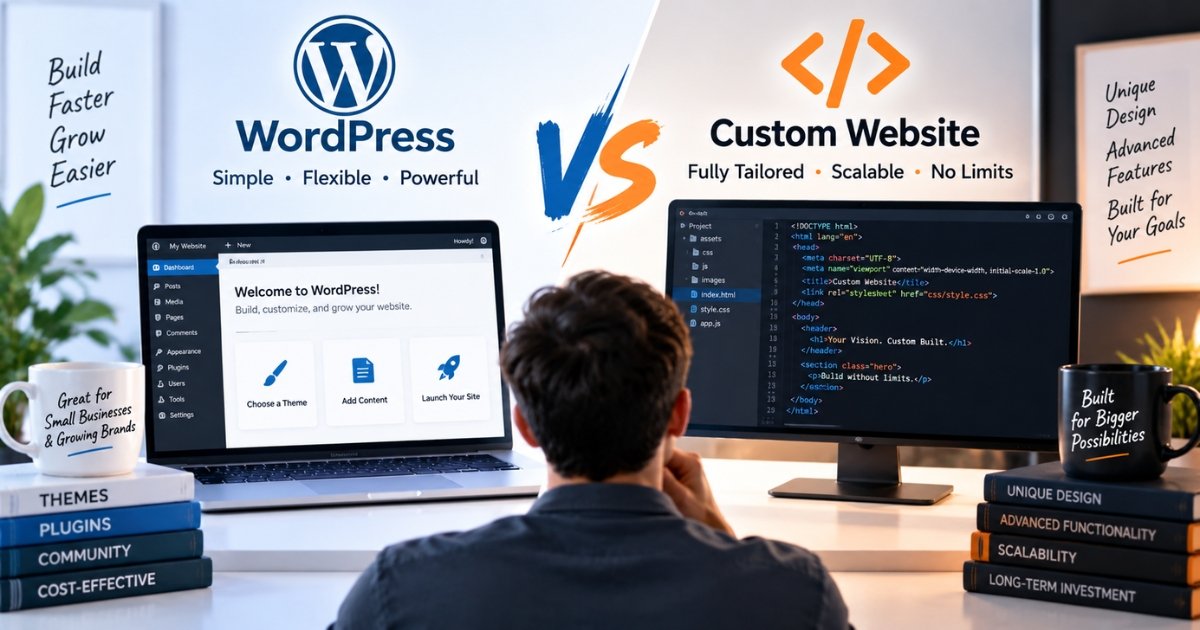
Any small business should have a functioning website. However, before you start building, you need to choose between WordPress and custom website development. These two different approaches may affect the project’s cost, speed of development, and even future scalability. In this blog, we’ll cover the benefits and drawbacks of both WordPress and custom website development, so you can decide which option is the better fit for your business. Let’s start by breaking down what WordPress actually is.
What Is WordPress?
WordPress is a content management system (CMS) — a platform that allows for easier website development and management by providing ready-made tools and features. Websites built with WordPress use their own set of themes and plugins.
Advantages of WordPress
The advantages of WordPress include:
- Lower cost – both the core platform and most plugins and themes are open-source and free
- Variety of plugins that allow for tremendous customization and additional functionality
- User-friendly interface so that website management is accessible to anyone
Disadvantages of WordPress
The disadvantages of WordPress are:
- Less secure since the code is prone to errors and attacks
- WordPress requires constant updates, which can be resource-intensive and complicated.
- WordPress can be slow due to too many plugins or incompatible versions of software
Now that we’ve covered WordPress, let’s look at the alternative: a custom-built website.
What Is a Custom Website?
A custom website is developed without using a CMS. Website developers write the code from scratch to create a website with the specific features and functions a business needs.
Advantages of Custom Website
The advantages of custom websites are:
- Predictable and sometimes lower long-term cost since there is no need to purchase and maintain licenses for third-party software
- Faster performance due to a smaller size of the code
- Greater security because there is less code and it is written by one team of developers
Disadvantages of Custom Website
The disadvantages of a custom website include:
- Higher initial cost due to the required development time and effort
- Greater complexity and, therefore, a higher barrier to entry for future website management and updates
- A custom website requires developers to make changes, whereas WordPress allows website owners to do it themselves.
With both options defined, here’s how they stack up against each other on the factors that matter most.
WordPress vs Custom Website: The Comparative Analysis
The first factor most business owners weigh is cost.
Website Development Cost
Custom website development costs more initially since developers need to write program code from scratch. However, over time, the two options may balance each other out. In particular, businesses that use WordPress often have to spend money on theme and plugin maintenance, whereas custom website development can offer easier management and, therefore, lower long-term costs.
Cost isn’t the only consideration — speed plays a major role in user experience and SEO too.
Website Speed and Performance
Custom website development is generally faster as there is less code involved in its operation. For WordPress, speed depends on how many plugins you use and how heavy your theme is — both can slow the website down.
Beyond speed, it’s worth thinking about how well each option can grow alongside your business.
Scalability and Flexibility
In the future, a custom website is likely to be more scalable and flexible. Such an option is ideal for businesses that expect rapid growth and need greater scalability, whereas WordPress is better suited to simple websites with basic content and functionality. In addition, custom-coded websites allow for finer-grained control over design and performance. Thus, companies with unique design requirements should choose custom website development.
Finally, consider who will be responsible for keeping your site running once it’s live.
Project Management and Maintenance
Custom websites tend to have fewer maintenance issues in the long term, since there are no plugin or theme version conflicts to manage. However, most changes still require a developer, so this option demands less hands-on involvement from a non-technical owner but more reliance on outside expertise. For these reasons, the higher initial cost of custom website development may be justified for businesses that prioritize stability over day-to-day control.
Which Option Should You Choose?
With all of this in mind, here’s how to decide which option is right for you.
Choose WordPress if:
- You have a limited budget to start your project
- You are developing a simple website and do not need additional functions beyond what is available in WordPress themes
- You need to make changes to your website yourself without hiring external experts
Choose custom website development if:
- You have specific requirements for your website design and functionality
- You operate in a highly competitive market and need an edge over your competitors
- You need corporate website design or other professional website design and development services
- You need b2b website development and have specific requirements for functionality
- You engage in ecommerce at scale and need ecommerce website design or development services
For many growing ecommerce brands, a hybrid option like Shopify website design or Shopify website development also fits well, combining an easier content workflow with strong ecommerce-specific features.
Conclusion
There’s no single right answer between WordPress and a custom website. WordPress suits businesses that want a cost-effective, manageable site. A custom build suits businesses that need tailored performance, tighter security, or complex functionality. The right choice depends on your budget, your technical resources, and where your business is headed.
If you’re weighing your options, our team offers website design and website development services, from WordPress builds to fully custom website development services, so you can start with a plan that matches your goals.
Running an online store? XPO Outdoors offers ecommerce website design and development services, including Shopify, so you can find the right setup for your catalog.
Still have questions? Here are answers to some of the most common ones.
Frequently Asked Questions
1. Is WordPress better than a custom website for small businesses?
It depends on your budget and your needs. WordPress is often the better fit for small businesses that want a cost-effective, easy-to-manage site. A custom build makes more sense once your requirements outgrow standard themes and plugins.
2. What is the cost difference between custom website development and WordPress?
Custom website development typically costs more upfront because everything is built from scratch. WordPress is cheaper to start with, since it uses existing plugins and themes, but costs can grow depending on the features you need.
3. Can XPO Outdoors build an ecommerce website on Shopify or WordPress?
Yes. We offer ecommerce website design services and ecommerce website development on both platforms, including Shopify website design and Shopify website development, depending on which fits your catalog size and growth plans.
4. What is best for B2B companies, WordPress or a custom website?
Many B2B companies start with WordPress for their core marketing pages. If you need custom quoting tools, client portals, or complex integrations, b2b website design and b2b website development built as a custom solution usually performs better long-term.
5. How do I know if my business needs a corporate or custom website design?
For businesses that require a unique design and a special approach to website development, corporate website design is a great option that could be customised to a certain extent. If you do not have such requirements, WordPress is a perfectly fine choice that would meet all of your expectations.