
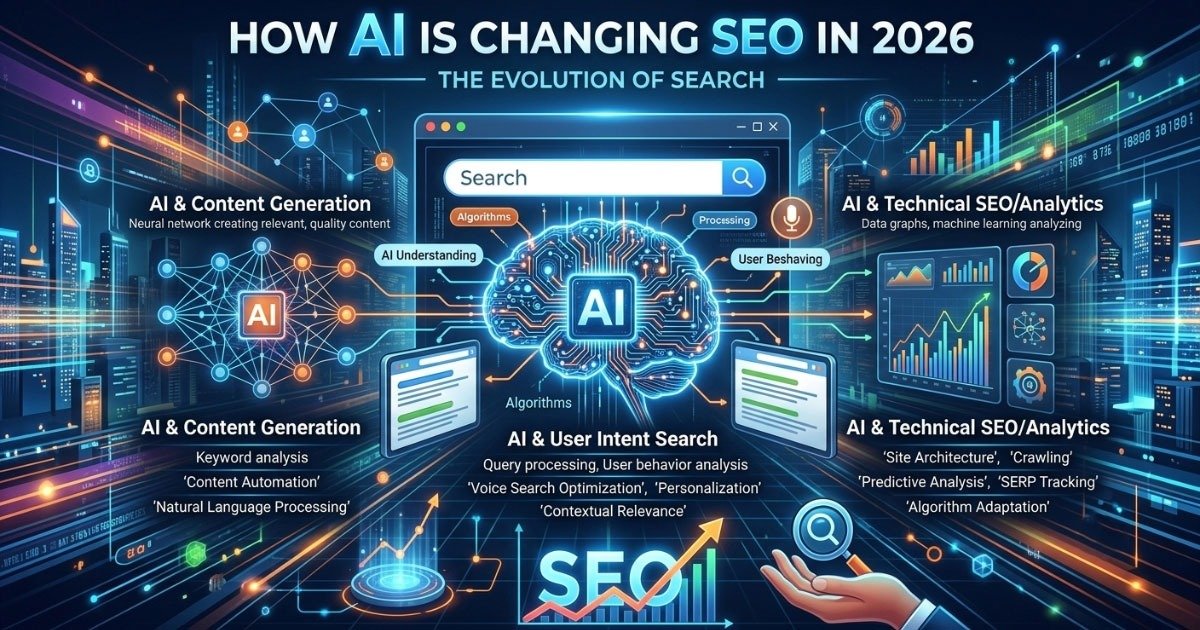
AI is changing SEO in 2026 by automating keyword research, analyzing search intent, and predicting ranking opportunities before competitors notice them. Search engines now reward content that demonstrates real expertise and experience, which is why Professional SEO Services that blend AI tools with human strategy consistently outperform automated-only approaches.
Internal Linking Suggestions:
- Link the phrase “building a fast, well-structured website” → Web Development Services
- Link the phrase “human-edited, expert-reviewed content” → Content Writing Services
- Link the phrase “improving user experience signals” → UI/UX Design Services
External Link Suggestions (authoritative sources):
- Google Search Central (developers.google.com/search) — for E-E-A-T and quality guidelines
- Google’s “Helpful Content” documentation
- Search Engine Land or Search Engine Journal — for current SEO trend reporting
Image Alt Text Suggestion: “Business owner reviewing AI-powered SEO analytics dashboard for search rankings in 2026”
How AI Is Changing SEO in 2026
Search engines don’t work the way they did even two years ago. If your business is still ranking pages the same way you did in 2023, you’re already behind. Artificial intelligence has quietly rebuilt the foundation of search, and in 2026, it’s no longer optional to understand it — it’s essential.
For small business owners, startup founders, and marketing managers across the U.S., this shift brings real opportunity. But it also raises a fair question: does AI make Professional SEO Services more important, or less?
The answer might surprise you — and it’s one every business searching for reliable Professional SEO Services should understand before choosing an agency.
What Is AI in SEO?
AI in SEO simply means using machine learning and automation to understand, predict, and improve how content performs in search. Instead of manually guessing which keywords matter or spending hours combing through analytics, AI tools can process enormous amounts of data in seconds.
This includes everything from identifying which topics your competitors haven’t covered yet, to predicting how a search engine will interpret a page’s intent. AI-powered SEO doesn’t replace strategy — it accelerates it, giving businesses faster, more accurate insights than ever before.
Major Ways AI Is Changing SEO in 2026
AI-Powered Keyword Research
Traditional keyword tools gave you search volume and difficulty scores. AI tools now go further, surfacing semantic keyword clusters, related questions, and emerging search trends before they peak — giving businesses a head start on ranking.
Smarter Content Optimization
AI can analyze top-performing pages and identify content gaps, missing subtopics, and structural improvements. This helps writers create more comprehensive, genuinely useful content rather than thin articles built around a single keyword.
Search Intent Analysis
Google has gotten remarkably good at understanding why someone is searching, not just what they typed. AI helps businesses match that intent precisely, whether a searcher wants a quick answer, a product page, or an in-depth guide.
Predictive SEO
Rather than reacting to ranking changes after they happen, AI can flag likely algorithm shifts and content opportunities before competitors catch on, making SEO strategy more proactive than reactive.
AI for Technical SEO
Site audits that once took days now happen in minutes. AI tools flag broken links, slow-loading pages, crawl errors, and indexing issues automatically, freeing up time for strategic work.
AI-Generated Content: Benefits and Limitations
AI can draft outlines, summarize research, and speed up production. However, fully AI-written content without human review often lacks depth, nuance, and originality — three things Google explicitly rewards. The best results come from AI-assisted, human-refined content.
Personalized Search Results
Search results increasingly reflect a user’s location, history, and behavior. This means a one-size-fits-all SEO strategy is losing effectiveness, and businesses need adaptable, intent-driven approaches.
Voice Search and AI
As voice assistants become more conversational, content optimized for natural language questions — not just short-tail keywords — is gaining a real advantage in visibility.
Visual Search
Tools that let users search with images are growing fast. Optimized alt text, image quality, and structured data now play a bigger role in discoverability than most businesses realize.
User Experience Signals
Google’s algorithms increasingly weigh how real users interact with a page — time on site, bounce rate, and engagement — making user experience an SEO factor, not just a design consideration.
Benefits of AI for Businesses
When used correctly, AI gives businesses a genuine edge. It saves hours of manual research, uncovers ranking opportunities faster, and supports data-driven decisions instead of guesswork. Many businesses see improved organic traffic simply because they can now identify and act on opportunities their competitors miss.
Just as importantly, AI tools make it easier to enhance user experience at scale, from faster page audits to smarter internal linking suggestions.
Challenges of AI in SEO
That said, AI isn’t a shortcut to guaranteed rankings. Over-reliance on automation often leads to generic, forgettable content that fails to build trust with readers or search engines. Google’s quality guidelines specifically call out thin, unoriginal content, regardless of how it was produced.
AI-generated drafts still require human editing to maintain brand voice, accuracy, and originality. Without that oversight, businesses risk publishing content that technically checks SEO boxes but fails to actually help or engage readers.
Why Human Expertise Still Matters
This is exactly why experienced SEO professionals remain essential in 2026. Strategy, content planning, brand voice, and technical judgment are areas where human expertise consistently outperforms automation alone.
AI can suggest what to write about. A skilled strategist decides why it matters, how it fits your broader goals, and how to present it in a way that earns trust — which is precisely what Google’s E-E-A-T guidelines reward.
How Professional SEO Services Help Businesses Stay Ahead
This is where Professional SEO Services make the real difference. The most effective approach in 2026 isn’t choosing between AI and human expertise — it’s combining both.
XPO Outdoors has built its approach around exactly this balance. By pairing AI-powered research and technical tools with experienced strategists, XPO Outdoors helps businesses identify opportunities faster while ensuring every piece of content still reflects genuine expertise and authenticity.
This means faster technical audits, smarter keyword targeting, and content that’s both optimized and genuinely valuable to readers, including building a fast, well-structured website, producing human-edited, expert-reviewed content, and improving user experience signals across every page.
For local businesses specifically, this combination also strengthens Local SEO efforts, helping companies show up when nearby customers are actively searching.
Professional SEO Services from a team that understands both the technology and the strategy behind it aren’t just helpful in 2026 — they’re a competitive necessity.
Conclusion
AI has fundamentally changed how search engines evaluate and rank content, but it hasn’t replaced the need for strategy, expertise, or genuine quality. The businesses that succeed in 2026 are the ones using AI to work faster, while relying on experienced professionals to make sure that speed doesn’t come at the cost of trust or originality.
If you’re looking for Professional SEO Services that combine AI innovation with proven SEO expertise, XPO Outdoors can help your business achieve sustainable search growth.
Frequently Asked Questions
1. Does AI replace the need for Professional SEO Services? No. AI speeds up research and technical analysis, but strategy, content quality, and brand trust still require human expertise. Professional SEO Services combine both for the best results.
2. Is AI-generated content bad for SEO? Not inherently, but unedited AI content often lacks depth and originality. Google rewards content that demonstrates real experience and expertise, which is why human review remains essential.
3. How has search intent analysis changed with AI? AI now helps identify not just what users search for, but why — allowing businesses to create content that matches the exact type of answer a searcher is looking for.
4. What is predictive SEO? Predictive SEO uses AI to anticipate ranking opportunities and algorithm shifts before they fully happen, allowing businesses to act proactively rather than reactively.
5. How does XPO Outdoors use AI in its SEO strategy? XPO Outdoors combines AI-powered tools for research, technical audits, and content analysis with experienced strategists who ensure every recommendation aligns with long-term business goals and Google’s quality standards.