
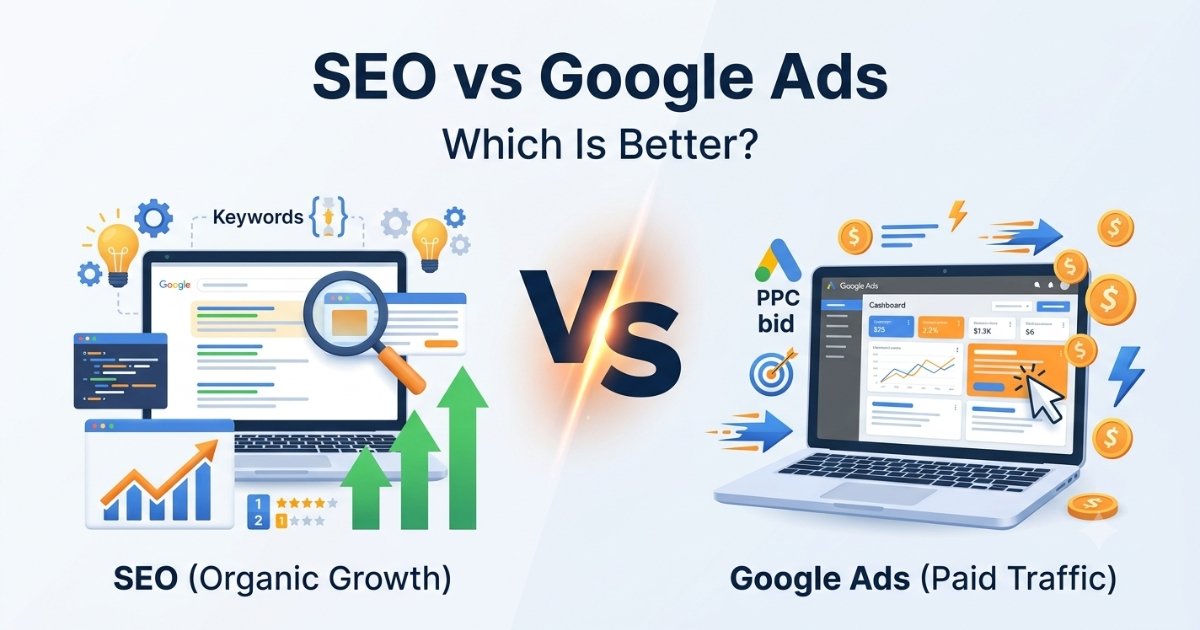
If you’re deciding where to put your next marketing dollar, this question has probably come up: SEO or Google Ads? Both promise visibility on Google. Both can drive real customers to your business. But they work in completely different ways, on completely different timelines, and the right choice depends entirely on what your business needs right now.
Let’s break down how each one actually works, where each one wins, and how to decide which fits your situation, or whether you need both.
What SEO Actually Does
Search engine optimization, or SEO, is the process of improving your website so it ranks organically, meaning without paying for placement, in search results. This includes keyword research, on-page optimization, technical fixes, and content creation that answers what your audience is actually searching for.
The upside of organic SEO services is that once a page ranks well, it can keep generating traffic for months or years without an ongoing cost per click. That’s what makes SEO a compounding asset rather than a recurring expense. The tradeoff is time. SEO typically takes several months to show meaningful results, since search engines need to crawl, index, and build trust in your content before rewarding it with strong rankings.
What Google Ads Actually Does
Google Ads is a pay-per-click, or PPC, platform. You bid on keywords, write an ad, and when someone clicks, you pay, regardless of whether they ultimately buy from you. Your ad can appear at the very top of search results the same day you launch a campaign.
This makes Google Ads the better choice when you need visibility immediately, whether that’s for a product launch, a seasonal promotion, or simply because your business is too new to have built any organic authority yet. The catch is that visibility disappears the moment you stop paying. There’s no compounding effect, only an ongoing cost.
Speed: Google Ads Wins
If you need traffic this week, Google Ads is the clear winner. Campaigns can launch in hours, and you can start collecting data on which keywords and offers actually convert almost immediately. This is also why many businesses use Google Ads as a testing ground to validate messaging and demand before investing heavily in long-term SEO content around the same topics.
Long-Term Cost: SEO Wins
Google Ads costs scale with clicks. More traffic means more spend, indefinitely. SEO has an upfront investment, research, content, technical work, but a well-optimized page can continue attracting visitors long after the work is done, without paying per visitor. Over a one- to two-year horizon, businesses that invest consistently in SEO often see a lower cost per acquisition than those relying solely on paid search.
Trust and Click-Through Behavior
Many users instinctively skip past ads and click organic results first, particularly for informational or research-driven searches. Organic rankings can carry an implied credibility that ads don’t automatically have, since users know a top organic position was earned rather than purchased. That said, for highly commercial, ready-to-buy searches, ads often perform just as well, sometimes better, because the searcher already knows what they want.
When to Choose SEO
SEO tends to be the stronger long-term choice when:
- You’re building a brand and want sustainable, compounding visibility
- Your budget can’t support ongoing per-click costs indefinitely
- You have the patience for a multi-month ramp-up period
- Your industry has meaningful organic search volume worth targeting
When to Choose Google Ads
Google Ads tends to be the better fit when:
- You need leads or sales immediately
- You’re testing a new offer, product, or market
- Your website doesn’t yet have the authority to rank organically
- You want fast, direct feedback on which keywords and messages convert
Why Not Both?
In practice, the strongest strategy usually isn’t SEO versus Google Ads, it’s SEO and Google Ads, sequenced intentionally. Many businesses use Google Ads early to generate fast data on what converts, then apply those same insights, which keywords, which offers, which messaging, into a long-term SEO content strategy. Paid search shows you the truth quickly. SEO turns that truth into a lasting asset.
This is exactly where working with professional SEO services makes a measurable difference. Building organic visibility the right way, based on real search intent and technical best practices, rather than guesswork, is what separates SEO that eventually pays off from SEO that quietly wastes a year of effort.
Making the Right Call for Your Business
There’s no universal answer to whether SEO or Google Ads is better, because the honest answer depends on your timeline, budget, and goals. If you need results this month, lean into paid search. If you’re building for the next few years, organic SEO deserves serious investment. Most growing businesses eventually need both, working together rather than competing for budget.
If you’re unsure where to start, XPO Outdoors offers some of the best SEO services for businesses trying to make that decision with real data instead of guesswork, helping you figure out where your marketing budget will actually work hardest.
Frequently Asked Questions
1. Is SEO cheaper than Google Ads?
the long term, yes, usually. SEO has upfront costs but no per-click charges, while Google Ads costs scale continuously with traffic. Short-term, Google Ads can sometimes be the more cost-effective option while SEO is still ramping up.
2. How long does SEO take to show results?
Most businesses start seeing meaningful organic movement within three to six months, with stronger results building over six to twelve months, depending on competition and starting authority.
3. Can I stop Google Ads once my SEO ranks well?
You can, but many businesses choose to run both simultaneously, using ads for immediate, high-intent searches while SEO continues building long-term organic reach.
4. Which is better for a new business with no website authority?
Google Ads often makes sense first, since a brand-new site typically needs time to build the trust required for strong organic rankings. SEO efforts should start early, but ads can fill the visibility gap in the meantime.
5. Do SEO and Google Ads target the same keywords?
They can, but strategy often differs. Google Ads works well for immediate, high-intent commercial keywords, while SEO can also capture broader informational searches that build authority and support the buyer’s journey earlier on.