
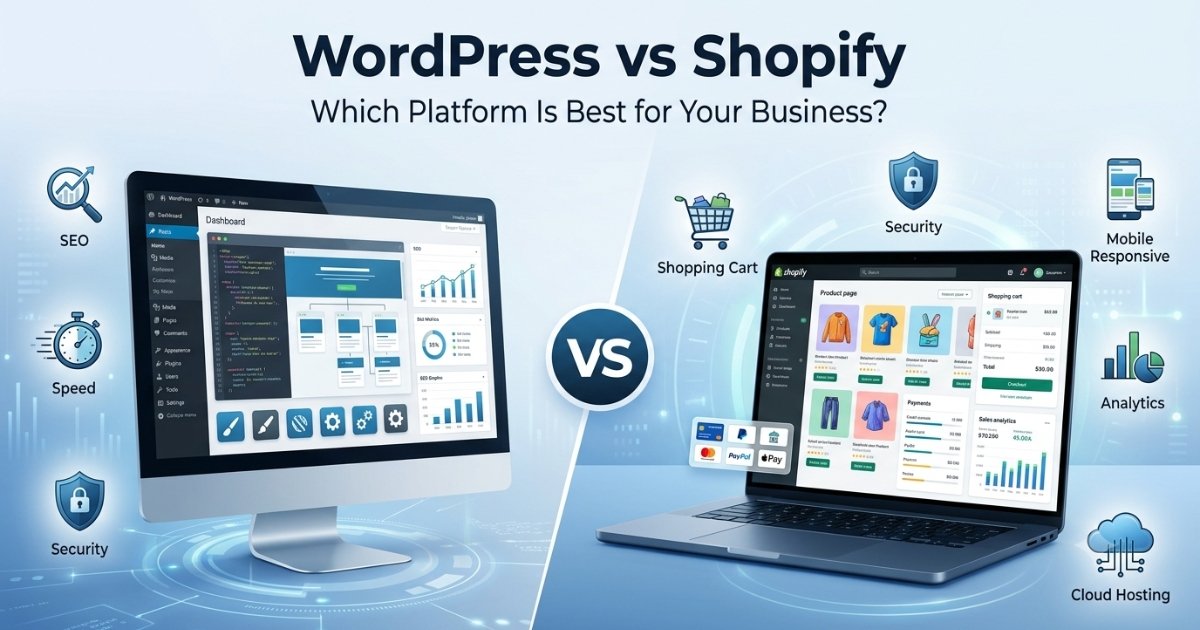
Choosing a website platform feels like a small decision until you’re two years in and realize you built on the wrong foundation. The CMS you pick shapes how easily you can grow, how well you rank in search, how much you pay every month, and how much control you actually have over your own site. At Xpo Outdoors, this is one of the first questions we help clients work through before any design or development begins.
WordPress vs Shopify is one of the most common platform debates for a reason. Both are proven, widely used, and capable of powering serious businesses. But they’re built for different jobs, and the “best” choice depends entirely on what your business actually needs to do online.
This guide breaks down the real differences, not just feature checklists, so you can make a decision that still makes sense three years from now.
What is WordPress?
WordPress is an open-source content management system that powers a large share of the websites on the internet. It started as a blogging tool and grew into a flexible platform capable of running everything from personal blogs to large corporate websites.
Because it’s open-source, WordPress gives businesses near-total control over design, functionality, and hosting. There’s no monthly platform fee baked in, and thousands of free and premium plugins let you add almost any feature imaginable, from booking systems to membership portals.
That flexibility comes with a tradeoff: WordPress requires more hands-on management. You’re responsible for choosing hosting, keeping plugins updated, and maintaining security, either yourself or through a development partner. For content-driven businesses, corporate websites, and service-based companies that want full ownership of their platform, that tradeoff is usually worth it.
What is Shopify?
Shopify is a hosted, all-in-one eCommerce platform built specifically for selling products online. Instead of assembling hosting, security, and functionality separately, Shopify bundles everything into one subscription.
Store owners get built-in tools for product management, inventory tracking, payment processing, shipping calculations, and checkout, all designed to work together without custom development. Shopify handles server maintenance and core security updates automatically, which removes a lot of the technical burden small teams don’t have time for.
This makes Shopify especially appealing for businesses whose main goal is selling products, not managing a complex content strategy. The tradeoff is less flexibility outside Shopify’s ecosystem and ongoing monthly costs that scale with your store’s needs.
WordPress vs Shopify: Side-by-Side Comparison
| Factor | WordPress | Shopify |
| Ease of Use | Moderate learning curve | Beginner-friendly |
| Customization | Extensive, near-unlimited | Flexible within Shopify’s framework |
| Design Flexibility | Highly flexible with themes and custom code | Good, limited by the theme architecture |
| SEO | Excellent, very granular control | Strong, with some structural limitations |
| Performance | Depends on hosting and optimization | Consistently fast, managed infrastructure |
| Security | Self-managed, requires active maintenance | Managed by Shopify |
| Maintenance | Ongoing updates required | Minimal, handled by the platform |
| Scalability | Highly scalable with the right setup | Scalable, especially with Shopify Plus |
| eCommerce Features | Requires WooCommerce or a similar plugin | Native, built-in from the start |
| Apps & Plugins | Thousands of free and premium plugins | Large app store, mostly paid |
| Blogging | Best-in-class blogging tools | Functional but basic |
| Marketing | Highly flexible with plugins and integrations | Strong built-in marketing tools |
| Cost | Variable, based on hosting and plugins | Predictable monthly subscription |
| Support | Community-driven, or agency support | 24/7 platform support included |
| Ownership | Full ownership of code and data | Data lives within Shopify’s ecosystem |
WordPress vs Shopify for SEO
SEO capability is one of the most common deciding factors, and it deserves a closer look than most comparisons give it.
Technical SEO: WordPress gives developers direct access to code, meaning technical SEO elements like structured data, canonical tags, and crawl optimization can be fine-tuned exactly how you want. Shopify handles technical SEO well out of the box, but customization requires working within its theme structure.
URL structure: WordPress allows fully customizable URL structures. Shopify has some fixed URL patterns, particularly for product and collection pages, which limit flexibility for advanced SEO strategies.
Schema markup: Both platforms support schema, but WordPress plugins offer more granular control over exactly what structured data appears and how it’s configured.
Blogging: This is where WordPress pulls ahead significantly. Its blogging tools, category structures, and content organization were built for publishing at scale, making it easier to build topical authority over time.
Page speed and Core Web Vitals: Shopify’s managed infrastructure delivers consistently fast load times without much manual optimization. WordPress can match or exceed that speed, but it requires proper hosting, caching, and image optimization to get there.
Content marketing: Businesses planning to invest heavily in blog content, resource libraries, or long-form guides generally find WordPress easier to scale for content marketing.
Internal linking: Both platforms support internal linking, but WordPress’s plugin ecosystem offers more advanced tools for managing link structures across large sites.
For businesses where content marketing and organic search are core growth strategies, WordPress typically offers more SEO flexibility. For product-focused stores that need solid, dependable SEO without heavy content investment, Shopify performs well without extra configuration.
WordPress vs Shopify Pricing
| Cost Factor | WordPress | Shopify |
| Setup Cost | $0 (software) + design/development | $0 (software) + design/development |
| Hosting | $10 – $100+ per month, separate purchase | Included in subscription |
| Themes | Free to $200 one-time | Free to $350 one-time |
| Plugins/Apps | $0 – $500+ per year, varies widely | $0 – $2,000+ per year, varies widely |
| Maintenance | $50 – $500+ per month if outsourced | Minimal, mostly platform-managed |
| Transaction Fees | None, unless using certain payment plugins | 0% – 2% unless using Shopify Payments |
| Monthly Platform Cost | $0 (self-hosted) | $39 – $399+ per month depending on plan |
| Long-Term Cost | The variable can be lower with a lean setup | Predictable, but scales with growth |
WordPress can be cheaper for content-focused sites with modest hosting needs, but costs climb quickly once you add premium plugins, custom development, and ongoing maintenance support. Shopify’s pricing is more predictable since most of what you need is bundled into the subscription, though transaction fees and app costs add up for stores with complex needs.
Neither platform is universally cheaper. The real cost depends on how much customization and content your business requires.
WordPress vs Shopify for Different Businesses
Startups: Early-stage companies often benefit from WordPress’s lower entry cost and flexibility to pivot quickly, especially if the business isn’t primarily selling physical products.
Small Businesses: Service-based small businesses tend to do well on WordPress, where blogging and local SEO tools support lead generation. Small retailers often prefer Shopify for its simpler product management.
Corporate Companies: WordPress is generally the stronger fit for corporate websites needing extensive content, multiple departments, and custom integrations with internal systems.
eCommerce Stores: Shopify is purpose-built for this. Inventory management, shipping, and checkout are all native, reducing development time significantly.
Service-Based Businesses: Consultants, agencies, and professional services typically lean toward WordPress for its content flexibility and lead-generation tools.
Agencies: Marketing and creative agencies often prefer WordPress for portfolio flexibility and blogging power, though some use Shopify when managing client stores.
Personal Brands: Coaches, authors, and creators frequently choose WordPress for content-heavy personal brands, while those selling merchandise or products often add Shopify or a hybrid setup.
Pros and Cons
WordPress
| Pros | Cons |
| Full ownership of code and data | Requires ongoing maintenance |
| Extensive customization options | Steeper learning curve |
| Best-in-class blogging and content tools | Security is self-managed |
| Huge plugin ecosystem | Hosting must be sourced separately |
| Strong long-term SEO flexibility | Can slow down without proper optimization |
Shopify
| Pros | Cons |
| Easy to set up and manage | Less flexibility outside its ecosystem |
| Built-in eCommerce tools | Monthly subscription required |
| Managed hosting and security | Transaction fees on some payment methods |
| Reliable performance and uptime | Blogging tools are limited |
| 24/7 platform support | Customization often needs paid apps |
When Should You Choose WordPress?
WordPress makes the most sense when content and flexibility matter more than out-of-the-box simplicity. Consider it if:
- Your business relies on blogging, guides, or resource content to drive organic traffic
- You need highly custom functionality that off-the-shelf platforms can’t easily support
- You want full ownership of your website’s code and data
- Your site is primarily service-based, corporate, or informational rather than product-focused
- You’re building a long-term content strategy and need granular SEO control
A regional law firm publishing weekly legal insights, or a consulting agency building topical authority around its niche, is a strong candidate for WordPress.
When Should You Choose Shopify?
Shopify is the stronger choice when selling products online is the primary goal. Consider it if:
- Your core business model is direct-to-consumer product sales
- You want inventory, shipping, and checkout handled without custom development
- You’d rather pay a predictable monthly fee than manage hosting and security yourself
- Your team doesn’t have in-house technical resources for ongoing maintenance
- You plan to scale using Shopify’s built-in marketing and sales tools
A boutique clothing brand launching its first online store, or an established retailer moving from a marketplace to its own site, typically finds Shopify faster to launch and easier to manage day to day.
Expert Recommendation
There’s no universal winner in the WordPress vs Shopify debate, and any comparison that claims otherwise is oversimplifying a real decision.
If your business model centers on content, lead generation, or highly custom functionality, WordPress usually delivers better long-term value, particularly for SEO-driven growth strategies. If your business model centers on selling physical products efficiently, Shopify’s built-in eCommerce tools typically save time and reduce technical overhead.
Some businesses even use both, running a WordPress site for content and lead generation while operating a Shopify store for transactions, connected through smart integrations. The right answer depends less on which platform is “better” and more on what your business is actually trying to accomplish over the next few years.
How Xpo Outdoors Helps Businesses Build the Right Website
Xpo Outdoors works with businesses to figure out which platform actually fits their goals, rather than defaulting to one solution for every client.
The team handles custom website development for businesses with unique functionality needs, along with dedicated WordPress development and Shopify development for companies that want a proven, well-supported platform. Every build incorporates SEO-friendly development practices from the start, so search visibility isn’t something bolted on after launch.
Responsive design is standard across every project, ensuring sites perform well on any device. After launch, ongoing website maintenance and technical support keep sites secure, updated, and running smoothly.
Businesses weighing their options can explore Xxpo Outdoors’ web development services for a broader look at available builds, or dive into Shopify development services specifically for eCommerce projects. Companies wanting to strengthen visibility after launch can also look into SEO services, while those needing on-brand visuals or written content can explore graphic design services and content writing services.
Conclusio
WordPress vs Shopify isn’t really a question of which platform is superior. It’s a question of which platform matches your business model, your team’s technical capacity, and your growth plans. WordPress offers unmatched flexibility and content power for businesses building long-term SEO authority. Shopify offers speed, simplicity, and dependable eCommerce tools for businesses focused on selling products.
Both platforms can support a serious, professional business website when they’re set up correctly and matched to the right use case.
If you’re still weighing your options, Xxpo Outdoors can help you evaluate your specific needs and build a website on the platform that actually fits your business. Reach out today to start planning your site the right way.
FAQs
1. Is WordPress or Shopify better for a small business website? It depends on the business model. Service-based small businesses often do better on WordPress, while product-based small businesses usually find Shopify faster to set up and manage.
2. Can I sell products on a WordPress website?
Yes, using a plugin like WooCommerce, WordPress can support full eCommerce functionality, though it requires more setup than Shopify’s native tools.
3. Which platform is better for SEO, WordPress or Shopify?
WordPress generally offers more SEO flexibility, especially for content marketing and blogging, while Shopify provides strong, reliable SEO performance for product-focused stores.
4. Is Shopify more expensive than WordPress in the long run?
Not necessarily. Shopify’s costs are predictable through its subscription model, while WordPress costs vary based on hosting, plugins, and maintenance, which can be cheaper or more expensive depending on setup.
5. Do I need coding knowledge to use WordPress or Shopify?
Neither platform requires coding for basic use, but WordPress benefits more from technical knowledge or developer support for advanced customization.
6. Which platform is easier to maintain?
Shopify requires less hands-on maintenance since hosting and core updates are managed by the platform. WordPress requires ongoing updates and security monitoring, either in-house or through a maintenance plan.
7. Can I switch from WordPress to Shopify later, or vice versa? Yes, migrations are possible in both directions, though they involve careful planning around content, SEO rankings, and design to avoid losing traffic during the transition.
8. Is Shopify only for large eCommerce businesses? No, Shopify supports businesses of all sizes, from single-product startups to large multi-channel retailers, with pricing plans that scale accordingly.
9. Which platform loads faster, WordPress or Shopify?
Shopify offers consistently fast performance through its managed infrastructure. WordPress can match that speed with proper hosting and optimization, but it requires more active management.
10. What’s the best platform for a business that both sells products and publishes content?
Many businesses in this position use WordPress for content and lead generation while integrating Shopify or WooCommerce for transactions, combining the strengths of both approaches.