Every small business owner eventually faces the same dilemma: with a limited advertising budget, should you invest in Facebook Ads, Instagram Ads, or both?
Meta owns both platforms, and they run on the same underlying ad engine. But that doesn’t mean they perform the same way for every business. For outdoor retailers and gear companies specifically, the right choice comes down to one thing: who you’re trying to reach.
This guide breaks down the real differences between Facebook ads vs Instagram ads for small businesses, so you can put your budget where it will actually generate revenue.
The Shared Engine: Meta Business Suite
Meta Business Suite is the shared engine behind both Facebook and Instagram advertising. You can run a single campaign across both platforms at once, using similar targeting rules — age, location, interests, and behavior.
But running the same ad on both platforms doesn’t mean you’ll get the same results. Choosing the right platform for your outdoor business is a bit like choosing between two trails: both get you somewhere, but each suits a different kind of hiker.
Facebook Ads for Small Businesses: The Advantages
Facebook has the largest audience of any social platform, and it’s built for content that goes beyond a single image or video.
Strengths
Facebook’s targeting options are highly advanced — you can reach specific audiences by age, gender, location, or interest with real precision. It also excels at community building: a business page that keeps an audience engaged after the first interaction can generate ongoing, repeat revenue. Facebook rewards brands that post substantial, ongoing content, not just one-off promotions.
Audience
Facebook skews toward an older demographic and users looking for a community-driven experience. Businesses built around loyalty programs and informational content — like outdoor adventure guides or wildlife resources — tend to perform better here than on Instagram.
Case Example
A hunting guide service or an outdoor apparel brand focused on building a repeat-customer base will typically get more value from Facebook’s targeting tools and page-building features.
Instagram Ads for Small Businesses: The Advantages
Instagram is visual-first and skews younger, which makes it a strong fit for businesses where imagery and video sell the product.
Strengths
Instagram works especially well for aesthetically driven products — anything with appealing packaging or a strong visual identity. It leans on short-form video and Reels, and it’s a natural fit for influencer marketing, since users are more receptive to posts shared by creators they follow. In-app shopping features also make it easier to drive direct sales without sending users elsewhere.
Audience
Instagram delivers strong value for a younger, shopping-oriented audience. Outdoor apparel and accessories brands with a strong visual identity typically see better returns here than on Facebook, since color, lighting, and styling can meaningfully boost perceived product value.
Case Example
A premium outdoor apparel brand, or an adventure outfitter whose experiences are naturally shareable (think scenic hikes, gear shots, campsite photos), is well suited to an Instagram-first approach.
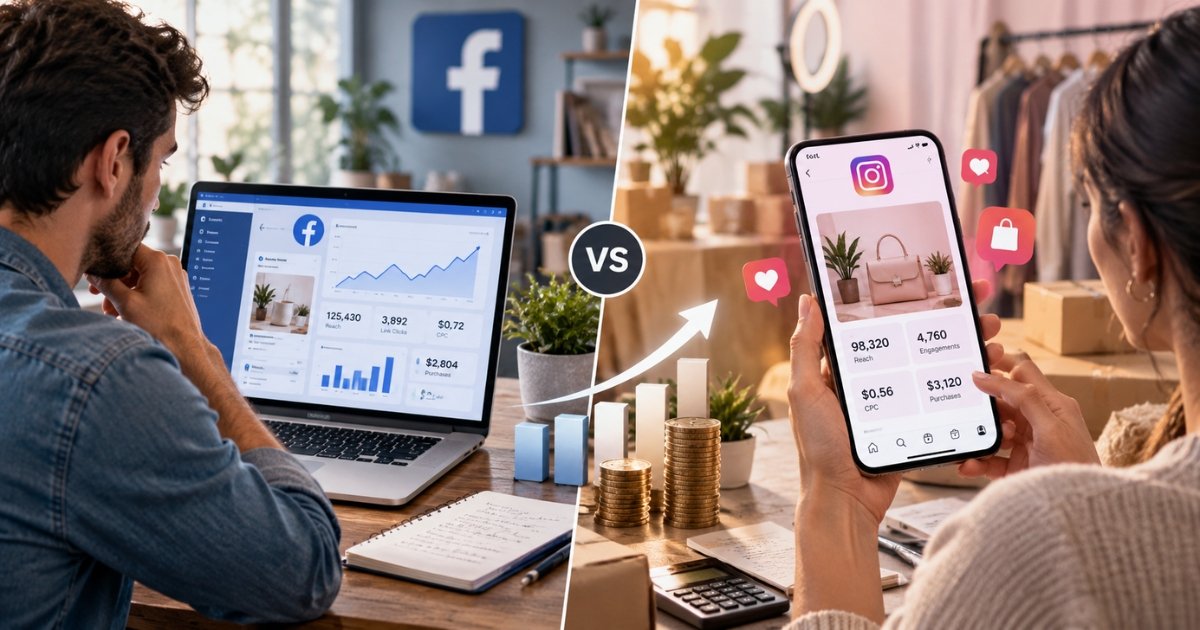
Facebook vs. Instagram: Side-by-Side Comparison
| Factor | Facebook Ads | Instagram Ads |
| Audience age | Skews older | Skews younger |
| Cost per click | Generally lower | Generally higher |
| Purchase intent per click | Lower | Higher |
| Best content format | Long-form posts, video | Short-form video, Reels |
| Best for | Community building, loyalty programs, informational content | Visually appealing products, influencer marketing, direct shopping |
| Ideal outdoor business type | Guide services, loyalty-driven brands | Apparel, aesthetic-driven gear brands |
Cost, Engagement, and Format: What Actually Differs
Cost and Engagement
Both platforms share the same Ads Manager dashboard, so cost comparisons are easy to pull. Cost per click tends to run higher on Instagram, but that’s partly offset by higher purchase intent — Instagram users are more likely to buy shortly after seeing an ad, which can make cost per purchase comparable across both platforms.
Audience Engagement
Users interact with the two platforms differently. On Instagram, a single view is often worth more, since viewers are more likely to act immediately. On Facebook, engagement tends to build over time — a well-run page with videos, slideshows, and consistent posting can generate strong returns even if individual posts convert more slowly.
Ad Format
The platforms don’t differ dramatically on format, since both support similar targeting and creative options. Facebook tends to reward longer-form video, while Instagram favors short-form content. Both support sales promotions, event tickets, and sponsorship-style ads.
What to Focus on When Comparing the Two
When deciding where to spend your budget, prioritize two numbers: cost per click and lifetime value per customer. If you’re weighing paid social against other channels entirely, it’s also worth comparing SEO vs. Google Ads to see where your budget goes furthest.A cheaper click that never converts is worse than a pricier one that turns into a repeat buyer. Track both before committing your full budget to one platform.
The Verdict: Which Platform Should You Choose?
There’s no universal winner — the right platform depends on your audience and your product.
- If your product or service appeals to a younger audience, lean into Instagram.
- If you’re targeting an older, more established audience, Facebook is typically the stronger investment.
- If you’re not sure, test both with a modest budget first, then shift spend toward whichever platform produces a lower cost per conversion.
A Real-World Example
Two outdoor businesses, each with a $500/month ad budget, took different approaches:
A hunting guide service put most of its budget into Facebook, targeting older hunters with Facebook’s precision targeting tools and a lead-generation form to streamline bookings.
A camping equipment brand put its budget into Instagram, running a series of product Reels and partnering with outdoor influencers to build visibility.
By the end of the month, the hunting guide service generated more revenue relative to spend — because its audience and targeting matched the platform. That’s the core lesson: platform choice isn’t about which is “better”; it’s about which matches your customer.
What This Means for Your Outdoor Business
Facebook and Instagram serve different purposes, and the right platform is the one that matches your target audience — not the one that’s more popular in general.
If you’re not sure which fits your business, start by testing both at a small scale, track cost per engagement and cost per conversion, then double down on the winner. Picking the wrong platform out of the gate can be an expensive way to learn this lesson — testing first is cheaper than guessing wrong.
XPO Outdoors Can Help
If you run an outdoor or retail business and aren’t sure whether Facebook, Instagram, or both make sense for your budget, XPO Outdoors can help you figure it out.
We build and optimize ad campaigns specifically for outdoor and retail brands, and we can help you determine which platform will deliver the most value for your marketing dollars. Contact us today for a free consultation, and we’ll help you put together a plan built around your actual audience — not a generic playbook.
Frequently Asked Questions
1. Which is cheaper: Facebook ads or Instagram ads?
Cost per click is generally lower on Facebook. However, purchase intent tends to be higher on Instagram, which often brings the cost per purchase to a comparable level across both platforms.
2. Can I run the same ad on both Facebook and Instagram?
Yes. Both platforms run through Meta Business Suite, which lets you launch a single campaign across both at once, with the ad automatically adapted to each platform’s format.
3. Is Facebook or Instagram better for my outdoor or retail business?
It depends on your target audience. Facebook tends to work better for guide services and loyalty-driven businesses targeting an older demographic. Instagram tends to work better for apparel and gear brands with a strong visual identity targeting a younger audience.
4. Do I need a business account to advertise on Instagram?
Yes. You’ll need an Instagram business account linked to a Facebook business page before you can start running ads.
5. How much should a small business spend on Facebook or Instagram advertising?
There’s no fixed number — it depends on your goals and market. A common approach is to start with a few hundred dollars a month, track cost per conversion on each platform, then scale the budget toward whichever platform performs better.